

The cut list
Your customers are slimming down their vendor lists. Someone will finish 'We HAVE to keep them because ___' about your company this year. Can they make the case for keeping you?
Rock Health reported 115 digital health acquisitions in the first six months of this year, with Q2 the busiest quarter for health tech M&A since late 2021.
As was foretold, the Great Digital Health Consolidation has arrived, people. Customers are slimming down their vendor lists like a Kardashian on Ozempic.
The companies that will make it into the next few years will have customers who can make a case for keeping them when the contract’s on the line.
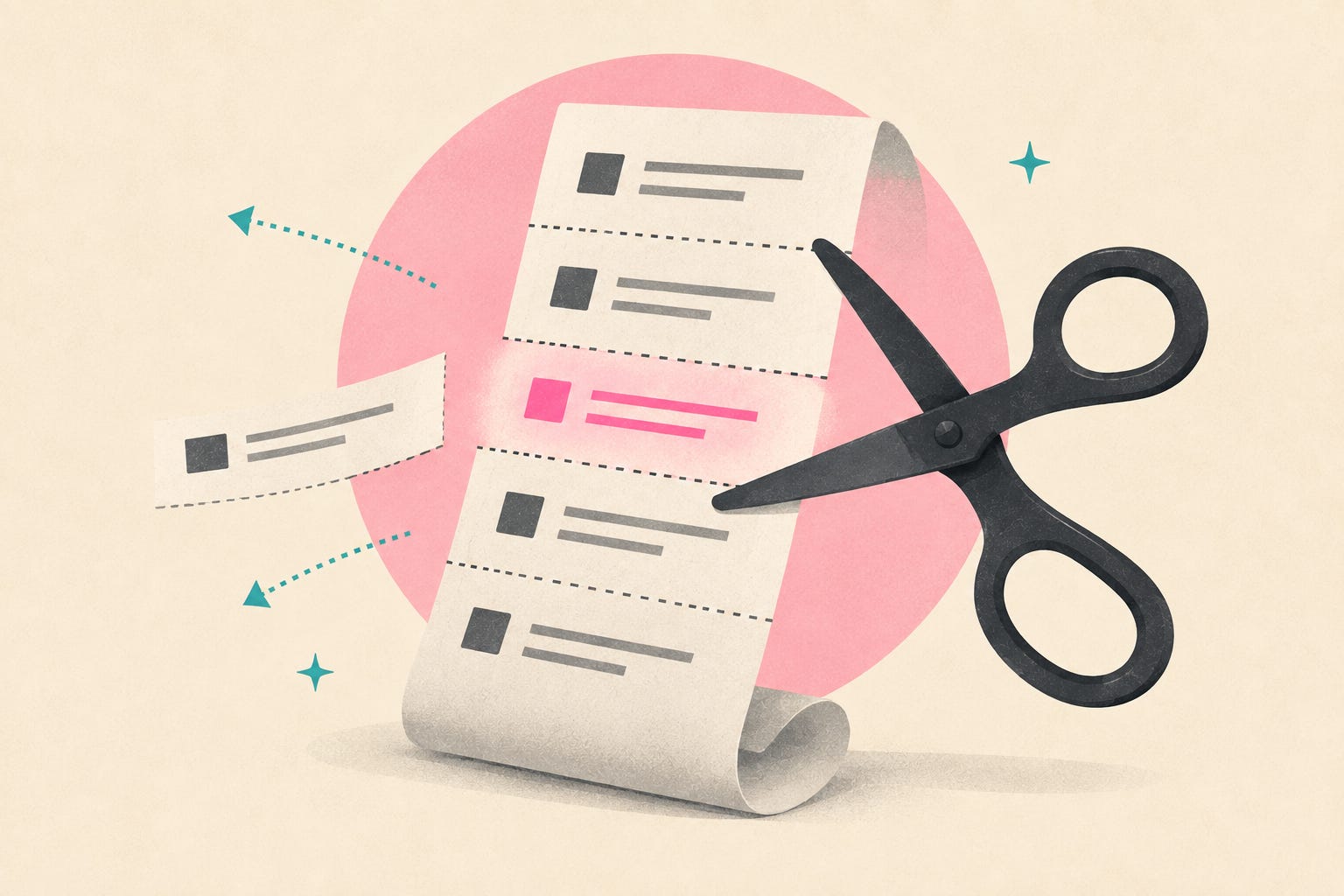
This consolidation wave points at three things. Valuations have corrected. Buyers want to see your path to profitability. And they want fewer vendors and more integrated platforms.
The last two in particular caught my attention. Buyers are feeling a little skittish. They want reassurance that you have a plan for the future. Your customers are also asking for more integration.
The companies getting absorbed have some things in common
I think the companies that will be acquired in this wave lack three things: a North Star, a clear focus and a strong go-to-market approach.
I can remember advising a health tech client a few years ago on positioning their point product as an advantage. There are still products on the market where that works, sure, but this buyer behavior is making point solutions a much harder sell.
The future belongs to breadth or depth
Breadth means a platform with a wide set of capabilities (and often it’s the one doing the acquiring). Depth means a real niche, strong outcomes and a pain nobody else on the market can fix.
Point solutions can still win, but undifferentiated ones will fight an uphill battle to articulate why they’re worth keeping. Meanwhile, health systems keep whittling away.
So if that’s you, I encourage you to force your mentality away from features. Talk about your outcomes, your profitability forecast and how you make nice with the platforms your customers are consolidating onto.
Your investor story has a side hustle
Health systems are doing a little more fortune telling now. They’re looking into their crystal balls and asking: will this vendor exist in three years? Who might acquire them? What happens to our contract and our data if that happens?
Remember driver two, your profit roadmap? You’re already telling that story to investors and board. Put a customer-focused version of it into your champion enablement materials as the deal moves forward: the plan to be around for a few years and what you’re doing now to grow the business. Get out ahead of that worry before it starts to spread through the deal like a bad infection.
Finish this sentence…
When a health system decides its dozen point solutions should become four integrated platforms, someone is going to have to finish this sentence about your company: “We HAVE to keep them because ___.”
You have words you can put into their hands and their mouths. That’s your job as CEO to articulate the answer, then marketing’s to get it into the right materials.
A quick and dirty exercise
One thing worth doing this week: Get the marketing and sales teams in a room with you and define who you are, clearly: an acquirer building breadth, an integrator that plays nicely with the platforms your customers already run or a point solution that solves a pain nobody else fixes.
It may be obvious to you and to leadership. But I’ve learned over many years that assuming everyone understands what you are is a dangerous assumption.
Then draft the MVP version of your positioning. Finish the sentence your buyers will finish with or without you: “We’re keeping them because ___.” One sentence, outcomes over features.
If your champion can say it from memory in a meeting you’re not in, then you nailed it. Get it on your site, in your deck and into your champion enablement.
The bottom line
This wave benefits companies buyers can describe in one sentence. If nobody at your company writes it, the buyer will write one for you, and you may not like their draft.

If you want to know whether your buyers could finish that sentence about you, that’s the first thing I look at in a Marketing Gap Analysis.
Keep Reading
The Revenue Hiding in Your Pipeline — what conversion you’re already leaving on the table before you spend another dollar on leads.
Selling to Health Systems Starts with Knowing the Journey, Not More Leads — Three healthcare buyers, three completely different timelines. Most stalled pipelines are a misread journey, not a lead problem.
The Question That Kills Health System Deals: “Whose Job Is This?” — sales looks at marketing, marketing looks at sales, and your champion pitches the CFO alone. The four-asset kit that closes the gap, and which team brings what.
About the Author
Heather Lodge, Fractional Chief Marketing Officer, The Hybrid CMO
Heather helps bring clarity to growing health tech and healthcare service companies that have the marketing talent but lack the strategic direction. She helps establish clear market positioning, lead focused account-based marketing programs and build the systems and teams needed to scale effectively. Heather takes the team and the budget you already have and makes them work harder. The right problems, the systems underneath, every dollar tied back to pipeline.