

Selling to Health Systems Starts with Knowing the Journey, Not More Leads
Before you push marketing for more pipeline, find out what stage your stalled deals are actually sitting in.


Most of health tech has some version of the same pipeline: deals that won’t die but also won’t close. Lots of meetings, plenty of “circling back next quarter,” but nothing signed.
And the “reason” is almost always the same. Marketing is sending sales junk leads.
Nine times out of ten, the leads are fine, but you’re working off of assumptions. No one ever mapped the journey those leads are on.
In journey mapping work I’ve done with health tech clients, I’ve charted the full path from status quo to signed contract across several different healthcare buyer types. Selling into skilled nursing facilities runs about 60 days. Independent medical groups take roughly six months. Health systems? Eighteen months, and that’s if things go well.
All three of these live under the same umbrella of “selling into healthcare,” and yet they are completely different timelines.
Different buyers, different clocks
Companies often build their marketing engine around whichever buyer said yes first. If your early traction came from medical groups, then your content cadence, your nurture sequences and your board’s pipeline expectations all got calibrated to a six-month cycle.
Then you move upmarket to health systems, and at month four everything looks stuck. Except it isn’t stuck. Those deals are at roughly the 20% mark of a journey you modeled at 60%.
This is where the problem gets misidentified. Your contact was engaged, the demo went great, then momentum faded into weeks of silence. You decide the lead was never real, or the messaging isn’t landing and push marketing to gin up more leads. More leads enter the same journey and get stuck again. Repeat until somebody gets fired.
What the journey looks like from the inside
The champion walked into the CFO’s office carrying enthusiasm and a demo recording. The CFO asked about total cost against the current workaround. The champion didn’t have that answer in hand, promised to follow up and got pulled into the next fire (there is always a next fire).
If that scene sounds familiar, it’s because it happens at a specific, predictable point in the journey. So let’s outline the whole thing.
Every buyer journey I’ve mapped tends to follow similar stages, whether it’s a six month cycle or 18 month cycle:
Status Quo. They know the pain, but they’re dealing with it. The workaround is annoying, but hey, it’s paid for.
Problem Awareness. The pain finally pushes someone to start researching whether it’s solvable.
Solution Exploration. They compare approaches. Build vs. buy. Fix the process vs. buy the platform.
Vendor Evaluation. Now you’re on the field. Demos, references and security questionnaires.
Internal Selling. Your contact takes the case to everyone who has to say yes, and often you’re never in the room for it.
Risk Assessment and Final Decision. Legal, procurement, implementation planning, and every last-minute reason to do nothing at all.
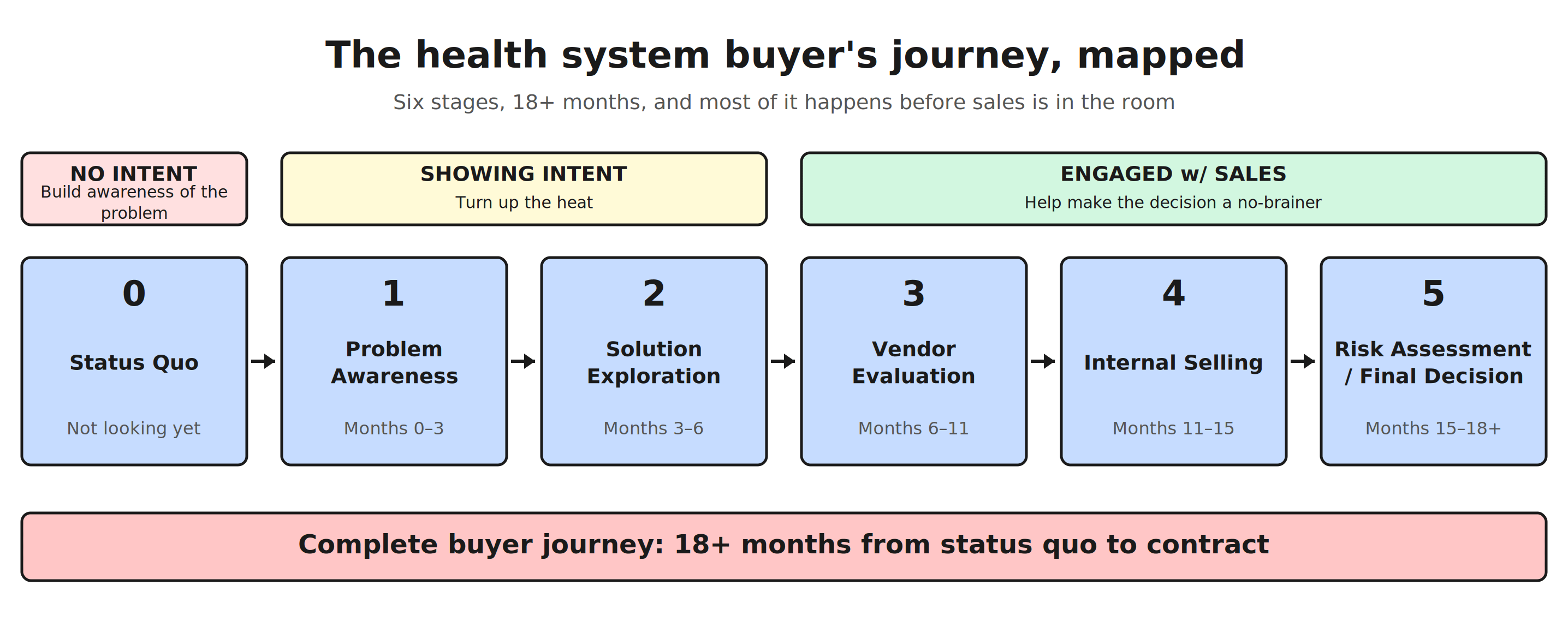
Two things about this matter enormously for marketing.
First, most of the journey happens before sales is involved. By the time a health system buyer talks to your team, they’ve usually done their own research, and either your content shaped their thinking during that stretch or a competitor’s did.
Second, the longest stage is one where neither sales nor marketing can see a thing. Which brings me to the most fragile part of the hospital procurement process…
Your champion is doing your selling for you
You hear “buying committee” and picture a room you can reach. Map the stakeholders, run some targeted ads, send the CFO a CFO-flavored eBook. That’s the version the martech vendors sell, anyway.
The reality inside often looks different. You don’t get the committee. You get one champion, usually the person who felt the pain first, and that champion goes back and re-pitches your solution to finance, IT, clinical leadership and compliance. And you’re crossing your fingers this champion can relay your value prop convincingly, and in the proper way to each of them.
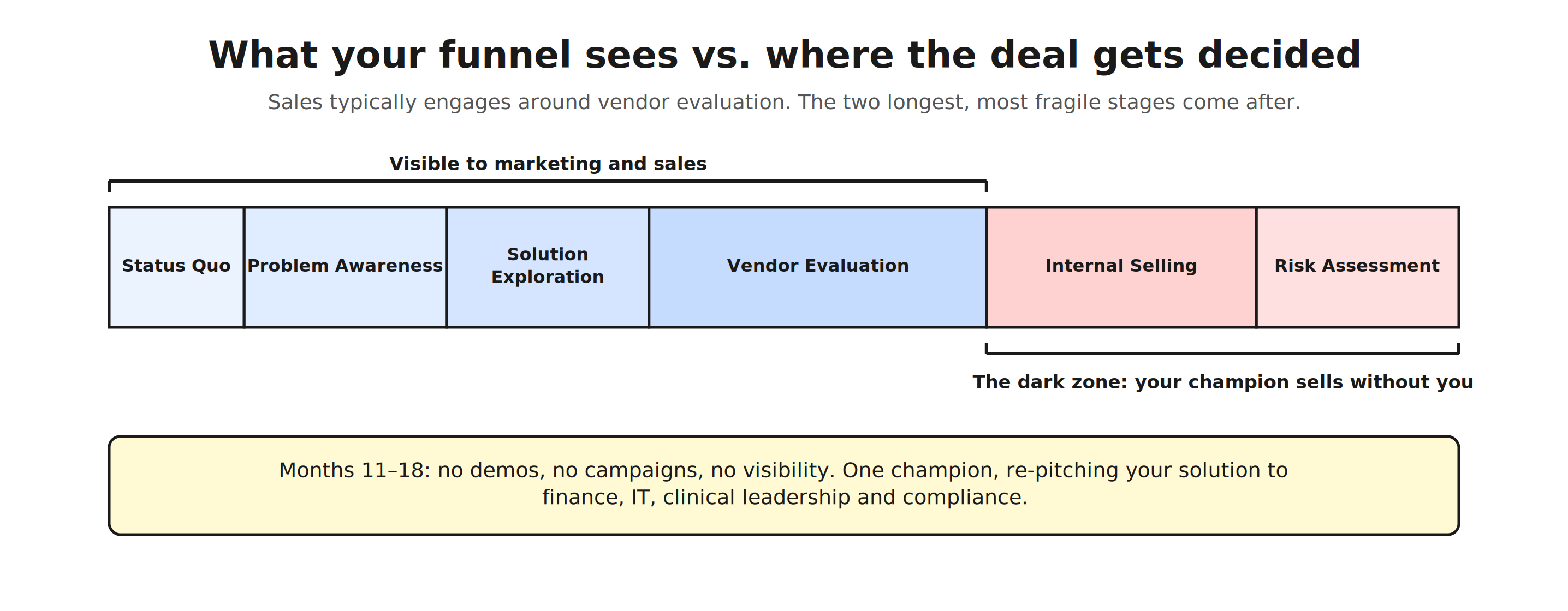
Your champion cannot forward your vibe. They can’t forward the energy of a great demo or your founder’s charisma on a Zoom call. They can forward a document. That’s it. That’s the whole channel.
So the test for every marketing asset becomes: could a mid-level operations person hand this to a CFO and have it answer the CFO’s question instead of the champion’s? If your entire content library is written to persuade the person who already believes, you’ve armed your champion with enthusiasm and a prayer.
The question worth asking on every active deal: is there a committee we can touch, or a translator we need to equip? (The honest answer is usually both. There’s a formal committee, and it operates through one very tired person.) Either way, your content rarely reaches decision-makers directly.
Match the content to the question
Once you see the journey clearly, marketing’s job gets a lot simpler to state: answer the question the buyer is asking at the stage they’re in. Most health tech marketing answers stage 3 (Solution Exploration) and 4 (Vendor Evaluation) questions for buyers sitting in stage 1 (Status Quo) and 2 (Problem Awareness).
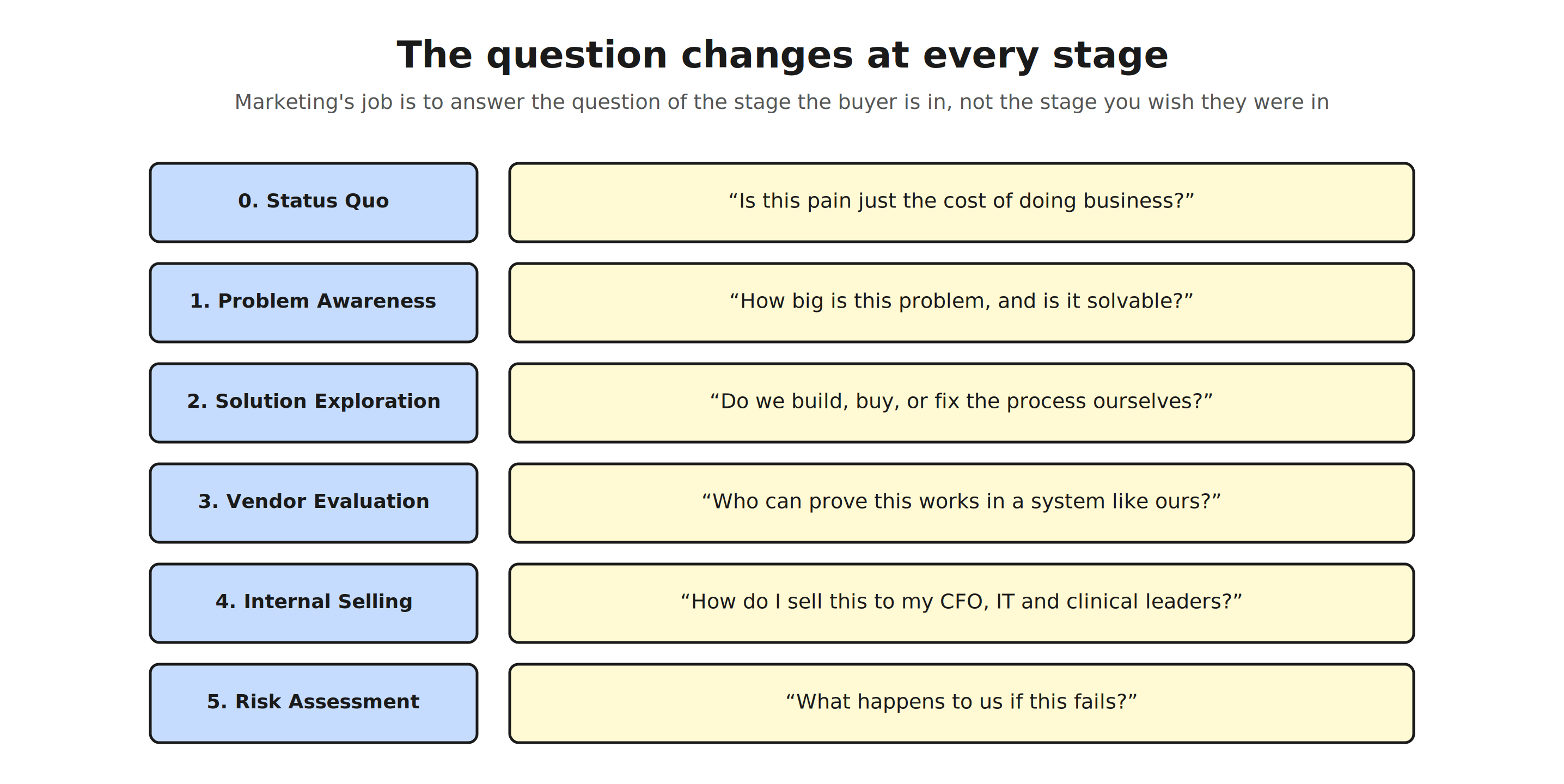
A few pairings straight from the maps:
Status Quo buyers need problem-framing content. What is this costing you today, what does solved look like, how have organizations like yours identified this problem. A demo at this stage is far too early.
Problem Awareness buyers need help defining and sizing the thing they just noticed. Diagnostic content, cost-of-inaction math, peer stories that make them say “oh, that’s us.” The vendor who gives the problem its vocabulary tends to shape the shortlist later, so this is where you want to show up first.
Solution Exploration buyers need honest comparison frameworks, including the option of doing nothing or fixing it internally.
Vendor Evaluation buyers need friction removed before they have to ask. Security documentation, compliance posture, integration requirements, implementation timelines. Boring? Absolutely. Deal-saving? Also absolutely.
Internal Selling champions need ammunition. A two-page ROI brief. A board-ready slide. Reference customers who match their profile. A real answer to “what’s the three-year cost against what we do now” written for a finance audience, not a marketing one.
Risk Assessment and Final Decision buyers need reasons not to be scared. A realistic implementation timeline, a named onboarding team, references who lived through go-live, and a straight answer to “what happens if this doesn’t work.” At this stage they’ve stopped asking whether your product is good. They’re asking whether saying yes could hurt them.
Now look at where the budget goes: almost entirely to stages 1 through 4, the visible part of the funnel. The internal selling stage, where those 18-month deals actually live or die, typically gets zero dollars.
I’d argue champion enablement is the least funded work in health tech marketing and the highest leverage.
The bottom line
If your health system pipeline looks stuck, resist the reflex to refill the funnel. Start with your pinch point. If you can identify where the pinch point is, you can put resources into fixing the problem first, then optimize the funnel working backwards.
Figure out what stage your stalled deals are in, then ask whether your buyer has what that stage requires in their hands. The answer is usually one specific missing asset, and it costs a whole lot less to build than another quarter of lead gen.
P.S. Next week, I’m going deeper on the internal selling stage: what a real champion enablement kit contains, and how to tell whether your champion is winning or drowning.

Not sure where your own engine is leaking? My Marketing Engine Diagnostic scores you across five dimensions in about four minutes, including whether your content maps to your buyer’s journey or just to your product roadmap.
Keep Reading
Why Health Tech Companies Stop Trusting Marketing — the case for treating marketing as one connected system instead of a pile of disconnected tactics. Start here if you’re new.
The Revenue Hiding in Your Pipeline — what conversion you’re already leaving on the table before you spend another dollar on leads.
You Probably Don’t Have The Marketing Problem You Think You Have — the four patterns these four fixes map back to, and why founders usually misread which one they’re in.
Everyone Buys Marketing Execution. Almost No One Buys Direction. — agency, full-time hire, senior doer or fractional leader. Which one fits, and which one most leaders default to.
About the Author
Heather Lodge, Fractional Chief Marketing Officer, The Hybrid CMO
Heather helps bring clarity to growing health tech and healthcare service companies that have the marketing talent but lack the strategic direction. She helps establish clear market positioning, lead focused account-based marketing programs and build the systems and teams needed to scale effectively. Heather takes the team and the budget you already have and makes them work harder. The right problems, the systems underneath, every dollar tied back to pipeline.