

Marketing never had a shot
Real direction, a number to answer to and someone with the authority to say no. Most functions never had all three.
You tell marketing what to do. Run the booth. Post more. Do PR.
You’re used to giving direction. You’re the CEO, after all. The problem is when you don’t know what you don’t know, you can give direction all day long and still not move the thing you want to move.
Of course you don’t want to cut Sales, and you’re not going to cut Product. I’m not going to argue that marketing’s more important than those two, or that money doesn’t matter when your runway’s running out. You have to make cuts somewhere.
But don’t cut marketing across the board just because you’re saying it doesn’t work, when it really hasn’t had the right conditions to work.

How you get here
Marketing is and should be so much more than a content engine or a graphic design shop. But a lot of marketers just aren’t very good. It pains me to say it about my own profession, but they just aren’t. Pretty decks, a busy trade show booth, a full content calendar, call it a day.
It’s fluffy. It’s fru fru.
You don’t always get what marketing should be, and marketing’s not doing itself any favors. It’s become a self-fulfilling prophecy in a way.
So you point at what you can see. PR, content, one-pagers, sales decks… the visible stuff. If you need to nurture people and keep yourself top of mind over an 18-month sales cycle, that requires different activities layered on top.
The issue is marketing’s just doing the things they’re told, not the things that would move the needle in the right direction.
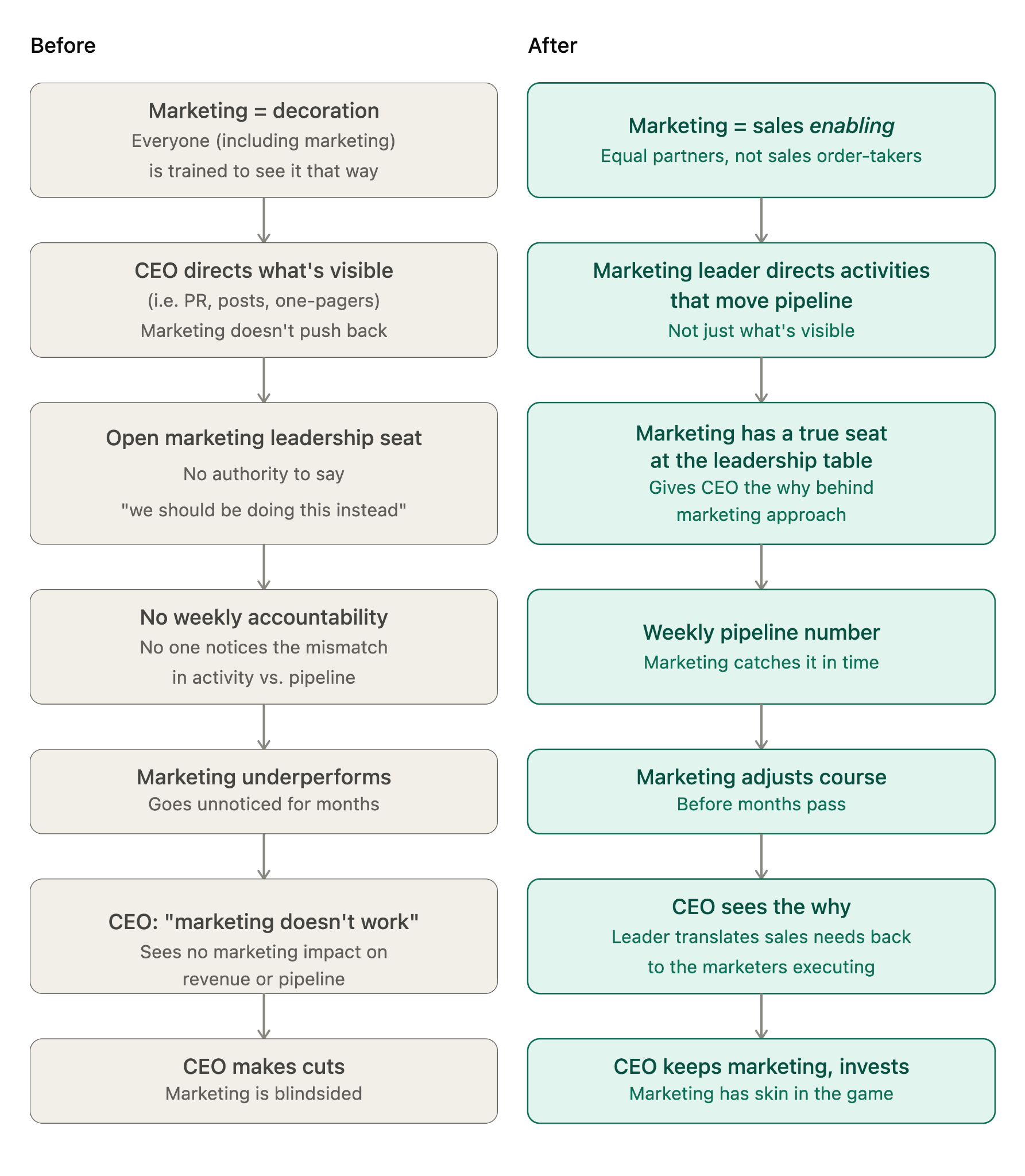
Without a seat at the leadership table, marketing has no authority to say “we should be doing this instead.” Without a weekly pipeline number to answer for, nobody’s forced to notice the mismatch between activity and revenue contribution.
So marketing underperforms for months, and nobody’s watching closely enough to catch it. You look up, see a flat pipeline and determine that marketing doesn’t work. You cut it.
And the marketer who did everything on that list is blindsided. She did everything asked of her. Nobody told her the list was never going to hit the number, because nobody had the authority to tell her, and nobody was checking often enough to catch it before the budget meeting.
How it’s supposed to work
Marketing’s treated as sales support when it should be sales enabling, an equal watching the same buyer from a different point in the journey, feeding information back and forth.
Marketing feeds sales the research and buyer behavior it’s picking up. Sales feeds marketing what’s moving deals and what the buying committee looks like in the room.
In most organizations , sales closes the deal and takes total credit for it. It should be “I was able to sell this because marketing did its job this whole time to make it easier for me.” And if marketing isn’t making the sale easier, what are they there for?
Track it: let’s say you determine marketing’s work over the life of a deal earns 30-40% of the “credit” (or whatever split makes sense to you), sales closes it and gets the other 60% or 70%. Now suddenly revenue is both teams’ responsibility. They just have different roles to play in it.
Then give marketing accountabilities instead of a task list. When marketing’s accountable to pipeline, and they have to speak to it and account for it weekly, that’s when their activity is forced to change.
Pivot to accountabilities over tasks and you fix both original problems. You aren’t giving tasks that aren’t moving the needle anymore, because now marketing (who are trained and experienced in knowing what works) is telling you how to hit your number. And marketers aren’t just fulfilling a task list for the sake of doing it, so when it doesn’t work out, they don’t get to say this isn’t fair. Now they’re hitting a number, and they’ve got skin in the game to decide how it gets done.
Having the marketing leader helps, too. Now marketing has a true seat at the leadership table, instead of a marketer with no authority doing whatever you ask. The leadership layer is the in-between. It gives you the why behind what’s happening, and translates the revenue and sales needs back to the boots-on-the-ground marketers doing the work.
One thing to do this week
Sit down with whoever runs marketing and ask one question: if you handed them a pipeline number instead of a task list, what would they stop doing, and why? The answer tells you what’s been funded because it’s visible, not because it works.
The bottom line
Before you make cuts to marketing, ask whether it ever had a real shot to begin with: real direction, a goal to answer to and someone with the standing to say no to the wrong ask. Most marketing functions never got the chance to prove they could.

If you want to know whether your marketing team ever had a real shot, that’s what a Marketing Gap Analysis is built to find.
Keep Reading
The Question That Kills Health System Deals: "Whose Job Is This?" — sales looks at marketing, marketing looks at sales, and your champion pitches the CFO alone. The four-asset kit that closes the gap, and which team brings what.
The Revenue Hiding in Your Pipeline — what conversion you’re already leaving on the table before you spend another dollar on leads.
You Probably Don’t Have The Marketing Problem You Think You Have — the four patterns these four fixes map back to, and why founders usually misread which one they’re in.
Selling to Health Systems Starts with Knowing the Journey, Not More Leads — Three healthcare buyers, three completely different timelines. Most stalled pipelines are a misread journey, not a lead problem.
About the Author
Heather Lodge, Fractional Chief Marketing Officer, The Hybrid CMO
Heather helps bring clarity to growing health tech and healthcare service companies that have the marketing talent but lack the strategic direction. She helps establish clear market positioning, lead focused account-based marketing programs and build the systems and teams needed to scale effectively. Heather takes the team and the budget you already have and makes them work harder. The right problems, the systems underneath, every dollar tied back to pipeline.